
To be read or listened to close Sukkot 5784 (Tishrei 21-22, 5784 / October 6-7th 2023) and to open Simchat Torah 5784 (Tishrei 23, 5784 / October 8th 2023) – https://podcasters.spotify.com/pod/show/sy-adamah
Seven Days (1)
“In the beginning God created the heaven and the earth.
And the earth was without form, and void; and darkness was upon the face of the deep. And the Spirit of God moved upon the face of the waters.”
Genesis 1:1-2 (KJV)
Prologue / Foreword
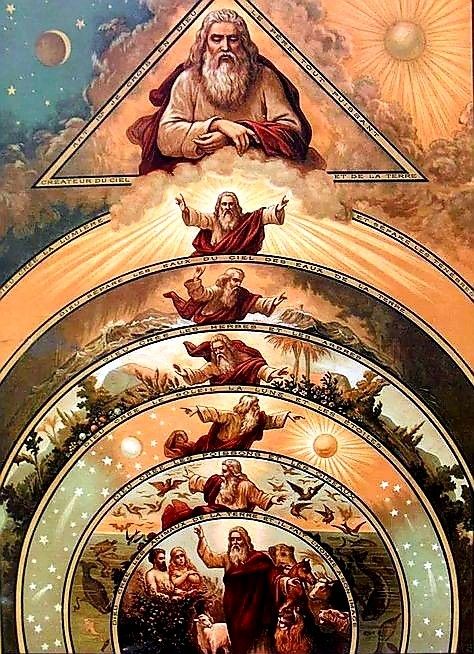
In the Bible, there is a pattern. This pattern is a cycle, a cycle of seven. This pattern is painted by words, words spoken and words written. This pattern is a rhythm, a rhythm which resounds, a rhythm which resonates. The rhythm of creation: a rhythm of revelation and rest. This rhythm was spoken, this rhythm was written. This rhythm was voiced from the very beginning, and penned in the very first pages of the Bible. This rhythm and these words are the very first words of the Father.
And God said, ‘Let there be light’: and there was light.
And God saw the light, that it was good: and God divided the light from the darkness.
And God called the light ‘Day’ and the darkness he called ‘Night’. And the evening and the morning were the first day.
Genesis 1:3 – 5 (KJV)
Day 1
This pattern, this cycle, this rhythm starts with a movement from darkness to light, from evening to morning. The rhythm of creation starts with the cycle of a single day, the first step in the rhythm that moves from revelation to rest.
And God said, ‘Let there be a firmament in the midst of the waters and let it divide the waters from the waters.’
And God made the firmament and divided the waters which were under the firmament from the waters which were above the firmament: and it was so.
And God called the firmament ‘Heaven’. And the evening and the morning were the second day.
Genesis 1:6-9 (KJV)
Day 2
And God said, ‘Let the waters under the heaven be gathered together unto one place, and let the dry land appear: and it was so.
And God called the dry land ‘Earth’; and the gathering together of the waters called he ‘Seas’: and God saw that it was good.
And God said, ‘Let the earth bring forth grass, the herb yielding seed, and the fruit tree yielding fruit after his kind, whose seed is in itself, upon the earth: and it was so.
And the earth brought forth grass, and herb yielding seed after his kind, and the tree yielding fruit whose seed was in itself, after his kind: and God saw that it was good.
And the evening and the morning were the third day.
Genesis 1:9-13 (KJV)
Day 3
This pattern, cycle and rhythm continues by creating a safe space. This safe space is in the centre, in the middle and in-between two extremes. The second step and third step of this pattern is creation of a sanctuary. The second step is creation of the firmament – the rāqîa – a shelter above us. This is ‘the Heaven.’ The third step is creation of a footing – the yabāšâ – a foundation below us. This is ‘the Earth.’ You could say this sanctuary or shelter in-between two extremes is like a tabernacle or tent with a covering above us and its pitch points below us. This is the Heaven and the Earth. A bridge between the heights and the depths. A balance between two extremes.
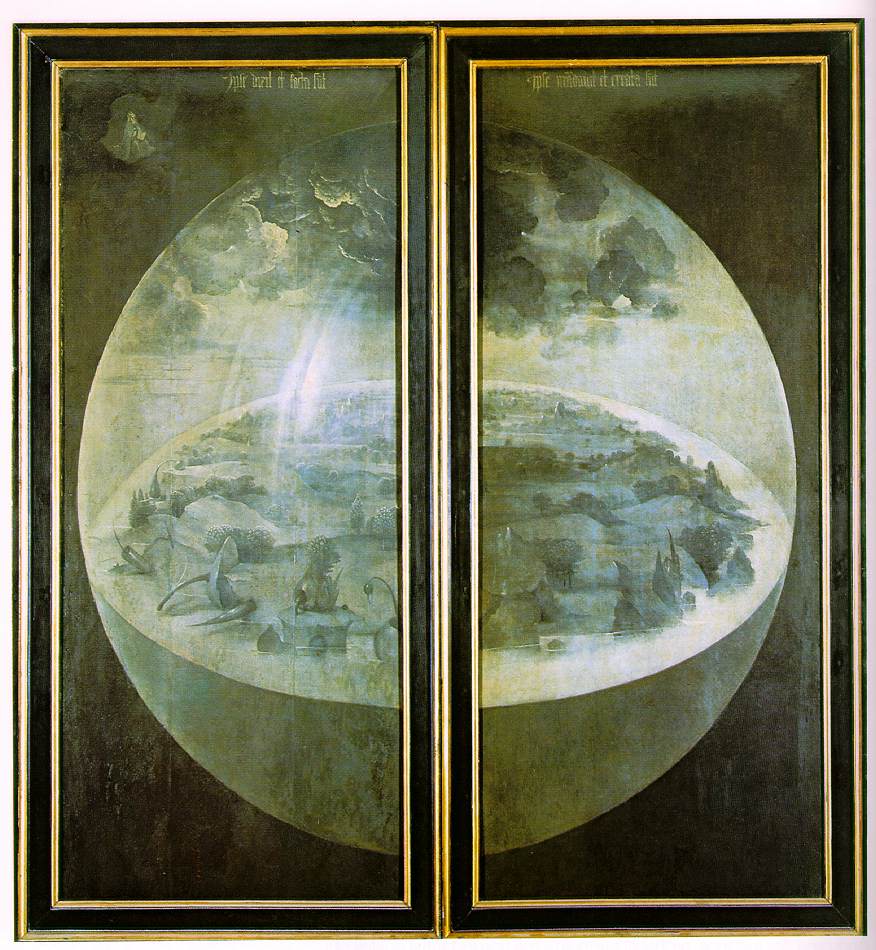
And God said, ‘Let there be lights in the firmament of heaven to divide the day from the night: and let them be for signs and for seasons, for days, and years:
And let them be for lights in the firmament of the heaven to give light upon the earth’: and it was so.
And God made two great lights; the greater light to rule the day, and the lesser light to rule the night: he made the stars also.
And God set them in the firmament of the heaven to give light upon the earth.
And to rule over the day and over the night, and to divide the light from the darkness: and God saw that it was good.
And the evening and the morning were the fourth day.
Genesis 1:14-19 (KJV)
Day 4
On the fourth day, at the centre of seven days, we find God multiplies the light found on the first day into three degrees: Sun, moon & stars.
These degrees coincide with specific cycles:
- The sun is “for days” going into weeks (i.e., evening and morning in a day; seven days in a week),
- The moon is for months going into “seasons” or feasts (i.e., four sets of seven days in a month; four seasons or seven feasts in a year)
- The daily cycle is governed by the Sun: what we experience as a repeated movement from sunrise to sunset, dawn to dusk, twilight to nightfall.
- The monthly cycle, i.e., the lunar cycle, is governed by the moon: what we experience as a repeated movement from new moon to new moon, a repeated and reversed movement from …
waxing crescent to half-moon (approx. 7 days),
from half-moon to full moon (approx. 7 more days),
and back again:
from full moon to half-moon (approx. 7 days),
from half-moon to waning crescent (approx. 7 more days).
The yearly cycle is commonly divided into four seasons: Autumn, Winter, Spring and Summer. Similarly, the monthly cycle can be divided into four weeks i.e., four sets of seven days. Biblically, however, the year can be divided into either three or seven. That is, divided into either …
Three Pilgrimage Feasts (Shalosh Regalim)
or
Seven Appointed Times (Mo’edim)
The Three Pilgrimage Feasts (Shalosh Regalim) take place in the first, third going into fourth and seventh months (Deut. 16) and the seven appointed times (Mo’edim) are spread from the first to the seventh months (Lev. 23).
Both divisions of three or seven mirror and coincide with the weekly cycle. The Three Pilgrimage Feasts (Shalosh Regalim) mirror and coincide with the first, third going into fourth and seventh days (I.e., the beginning, middle and end of the week). The Seven Appointed Times (Mo’edim) with the first going all the way through to the seventh day.
Three Pilgrimage Feasts:
- Passover (Pesach): celebrated from the middle of month 1 coincides with Day 1
- Weeks (Shavu’ot): celebrated at the centre of seven months coincides with Day 3 & 4
- Tabernacles (Sukkot): celebrated from the middle of month 7 coincides with Day 7
(Deut. 16)
Seven Appointed Times:
Passover / Pesach (1),
Unleavened Bread / Matzot (2),
First-fruits / Bikkurim (3),
Weeks / Shavu’ot (4),
Trumpets / Teruah (5),
Atonement / Kippur (6),
Tabernacles / Sukkot (7)
(Lev. 23 )
And God said, ‘Let the waters bring forth abundantly the moving creature that hath life, and fowl that may fly above the earth in the open firmament of heaven.
And God created great whales, and every living creature that moveth, which the waters brought forth abundantly, after their kind, and every winged fowl after his kind: and God saw that it was good.
And God blessed them saying., ‘Be fruitful, and multiply, and fill the waters in the seas, and let fowl multiply in the earth. And the evening and the morning were the fifth day.
Genesis 1:20 – 23 (KJV)
Day 5
And God said, ‘Let the earth bring forth the living creature after his kind, cattle and creeping thing, and beast of the earth after his kind’: and it was so.
And God made the beast of the earth after his kind, and cattle after their kind, and every thing that creepeth upon the earth after his kind: and God saw that it was good.
And God said, ‘Let us make man in our image, after our likeness: let them have dominion over the fish of the sea, and over the fowl of the air, and over every creeping thing that creepeth upon the earth.’
So God created man in his own image, in the image of God created he him; male and female created he them.
And God blessed them, and God said unto them, ‘Be fruitful, and multiply, and replenish the earth, and subdue it: and have dominion over the fish of the sea and over the fowl of the air, and over every living thing that moveth upon the earth.’
And God said, ‘Behold, I have given you every herb bearing seed, which is upon the face of all the earth, and every tree, in
thewhich is the fruit of a tree yielding seed; to you it shall be for meat.’And to every beast of the earth, and to every fowl of air, and to every thing that creepeth upon the earth, wherein there is life, I have given every green herb for meat: and it was so.
And God saw everything that he had made, and, behold, it was very good.
And the evening and the morning were the sixth day.
Genesis 1:24-31 (KJV)
Day 6
This cycle, pattern and rhythm continues with days 5 & 6 which return and run in parallel to the territory of days 2 & 3.
Day 1 – Light
Day 2 – Water
Day 3 – Earth
Day 4 – Lights
Day 5 – Water
Day 6 – Earth
In days 5 & 6, God adds a layer to the rhythm set in days 2 & 3. This layer is life. Life in the heights. Life in the depths. Life in the skies. Life in the seas. Life in the earth, that is, life in-between. Life on the land: wild and tame, crawlers and walkers. The upright: the image and likeness of God; the blessing and the burden of dominion.
Thus the heavens and the earth were finished, and all the host of them.
And on the seventh day God ended his work which he had made; and rested on the seventh day from all his work which he had made.
And God blessed the seventh day, and sanctified it: because
Genesis 2:1-3 (KJV)thatin it he had rested from all his work which God created and made.
Day 7
This pattern, this cycle and this rhythm of opposites is spread across the space of seven days, seven singular cycles of evening and morning which make a single week. There is some confusion about the workings of the week, but what we currently know to be the working week and the weekend are vague pointers with the potential to reveal the real bookends of a single week. These bookends of a single week are Sunday and Saturday, the first day and the Sabbath day, work from one end to rest on the other, revelation on the first to rest on the seventh.
Day 1 – Sunday …
Darkness to Light: ‘Day’& ‘Night’ (Revelation)
Day 2 – Monday …
Waters above and below (The firmament)
Day 3 – Tuesday …
Earth, grass, herbs and trees (The footing)
Day 4 – Wednesday …
Lights: the Sun, moon & stars (Multiplication)
Day 5 – Thursday …
Waters above and below (The sky and sea creatures)
Day 6 – Friday …
Earth, grass, herbs and trees (The land animals and Mankind)
Day 7 – Saturday …
Blessed and holy time (Rest)
The cycle of seven, the pattern of poetry and rhythm of creation begins with revelation and ends with rest. The cycle of seven, the pattern painted and the rhythm played is an archetype of space and time, a balance between art and arithmetic, a rhythm of beginning and end.
I am Alpha and Omega, the beginning and the ending, saith the Lord, which is, and which was, and which is to come, the Almighty.”
Revelation 1:8 (KJV)
What if God is revealing the pattern and not the particularities of creation here?
What if God is revealing who he is through these seasons and cycles?
What if God is simply saying he is the complete cycle of time, a complete cycle of seven?
The Beginning and the End
The Sunday and the Saturday.
The Revelation and the Rest.
The Alpha and the Omega.
One who was and who is to come:
Always and Eternal.
Simchat Torah (Re-joicing in the Torah) (2)
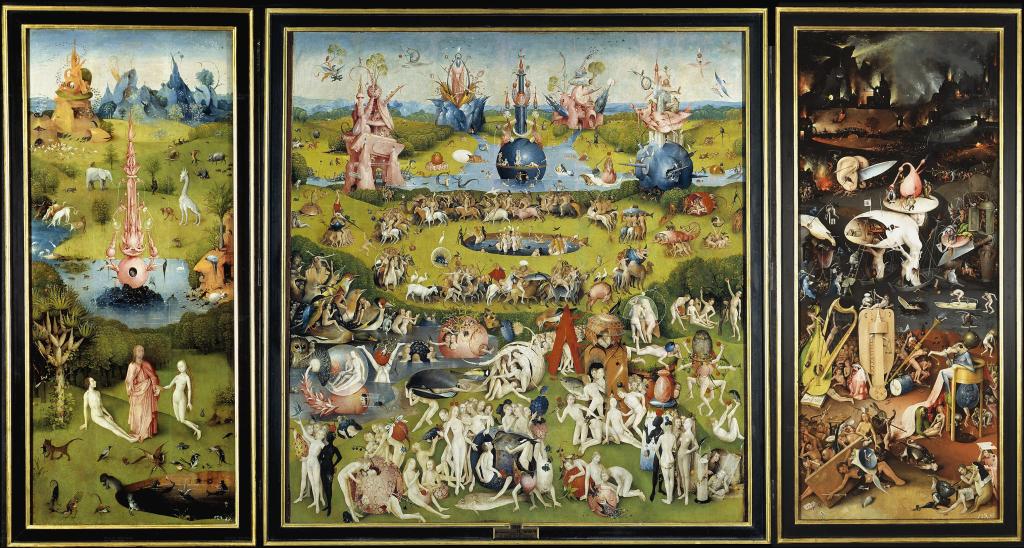
Sukkot is the seventh appointed time, the seventh biblical feast. Sukkot starts from the midst of the seventh month, the seventh full moon. As Sukkot ends, after the seventh (Hoshana Rabbah) and even after the eighth day (Shemini Atzeret), a new cycle begins: Simchat Torah.
The cycle of Simchat Torah is a practice in the Jewish community that is technically not based in the Hebrew Bible but grows from the soil of sacred Scripture.
Simchat Torah is a cycle of reading and re-reading the first five books of Moses within the Hebrew Bible.
In the common tongue, this collection of five is known as the Pentateuch (The Five Teachings)
Book 1 – Genesis
Book 2 – Exodus
Book 3 – Leviticus
Book 4 – Numbers
Book 5 – Deuteronomy
In Hebrew, this collection of five is known as the Torah (The Law or Instruction)
Book 1 – B’resheet – ‘In the beginning’
Book 2 – Sh’mot – ‘Names’
Book 3 – Vayikra – ‘And He called’
Book 4 – B’midbar – ‘In the wilderness’
Book 5 – D’varim – ‘Words’
These books are read in chronological order and spread out in the space of a single year. In the space of a single year, a single cycle of reading, beginning from Book 1 (Genesis / B’resheet) and ending in Book 5 (Deuteronomy / D’varim), is complete and the cycle starts over once again with entry into a new year. This cycle of reading coincides with the cycle of seasons. The cycle of reading begins in Autumn, the morning after the festival of Sukkot (Tabernacles) and ends in Autumn, in the evening of the eighth day of Sukkot (I.e., Shemini Atzeret). In other words, the new cycle of reading begins the day after the cycle of seven biblical feasts outlined in Leviticus 23 ends …
Passover / Pesach (1),
Unleavened Bread / Matzot (2),
First fruits / Bikkurim (3),
Weeks / Shavu’ot (4),
Trumpets / Teruah (5),
Atonement / Kippur (6),
Tabernacles / Sukkot (7)
… and ushers in yet another cycle of reading throughout the four seasons: Autumn, Winter, Spring, Summer … Autumn again.
At this point you may ask, ‘Why would you find this inspiring? Wouldn’t this get dry, repetitive, and boring?’ On the surface, this practice may seem dry, repetitive, and boring, but this repeated cycle is inspiring because it reminds me of a rap lyric that has resonated with me ever since I first heard it spoken:
“My picture should be in the dictionary next to the definition of ‘Definition’ because repetition is the father of learning” –
Lil Wayne, Shoot Me Down, Verse 2
This may seem like a random reference and connection I’m making here but the phrase “repetition is the father of learning” has stuck with me ever since my adolescence and resonates with me because on some deeper level it may remind me or point to a key instruction given by Moses in his final address to the Israelites.
“Listen, Israel. The LORD our God, the LORD is one.
Love the LORD your God with all your heart, with all your soul, and with all your strength. These words I am giving you today are to be in your heart. Repeat them to your children. Talk about them when you sit in your house and when you walk along the road, when you lie down and when you get up. Bind them as a sign on your hand and let them be a symbol on your forehead. Write them on the doorposts of your house and on your city gates.”
Deuteronomy 6:4-9 (CSB)
Repeat these words to your children. Talk about these words always. Bind these words as a sign. Write these words everywhere.
Before his death in the Book of Deuteronomy, Moses summoned and reiterated the Ten Commandments to the Israelites in Deuteronomy 5 and then followed with this key instruction in Deuteronomy 6.
Later down the line and in Jewish history, Jesus recognised these words of instruction to be the greatest or most important commandment in three of the four Gospel accounts:
- Matthew 22:34 – 38;
- Mark 11:28-29;
- Luke 10:25-28
As such, we can see why Moses’ words have been a source and seed of inspiration for Jewish communal worship. These words in Deuteronomy are known as the Shema prayer. Shema is the Hebrew word for ‘Listen’ and is a word that Moses repeats throughout Deuteronomy to stress and emphasise the importance of hearing and following God’s words of instruction. Because of this, what has now become known as the Shema prayer is repeated, reiterated, and recited daily as the centrepiece of communal prayer in both evening and morning worship.
Unfortunately, reading the Bible can be intimidating because it is so big, so vast, so complex and so much to take in that you may wonder where to begin. Even as an adult, learning the Bible can be intimidating let alone speaking, teaching and repeating it to your children. There is so much content, so little time and so many responsibilities in adult life – where do you begin to teach and repeat to your children?
Thinking about this problem, I often play with the following question:
“If you had a friend or mentee who was new to the faith and you had to recommend a book in the bible to begin with (and possibly live with), which book would you recommend?”
I often ask this question to friends in the faith for fun, but in the process, I often gain an insight into the character and values of the person who answers: an insight into their personality and what this person sees as important when introducing and seeking inspiration from God.
Although I’m intrigued and respect the thought, reasoning and emotion behind my brothers and sisters when they answer this question, I am inclined to agree with those who say that they would recommend the Book of Genesis. Not everyone would agree with this. In fact, and ironically, I have even heard someone recommend the Gospel of John instead and say, “Genesis is the worst place to start!”
So why do I choose it?
In the NIV translation of Deuteronomy 6 it reads:
“Hear, O Israel: The LORD our God, the LORD is one.
Love the LORD your God with all your heart and with all your soul and with all your strength. These commandments that I give you today are to be on your hearts. Impress them on your children. Talk about them when you sit at home and when you walk along the road, when you lie down and when you get up. Tie them as symbols on your hands and bind them on your foreheads. Write them on the doorframes of your houses and on your gates.”
Deuteronomy 6:4-9 (NIV)
Impress these commandments onto your children. Talk about them always. Tie them as symbols. Write them everywhere.
If this is the case and God’s command, wouldn’t it be fitting to start at the very beginning?
If we are attempting to impress God’s words onto our children or make a good first impression of who God is to a friend or mentee, shouldn’t we start and speak with the Father’s first words?
If we are planning to teach and repeat, cycle and re-cycle God’s words, wouldn’t it make sense to start with the source of inspiration and seed of sacred Scripture?
Instead of wondering where to begin in reading the Bible, Simchat Torah structures a cycle of communal reading and spiral learning that a child is born into and brought up in. This cycle of communal reading is also one that a friend or mentee could be easily initiated and ingrafted into wherever they are in life. I find the cycle of Simchat Torah inspiring because in the space of a single year, the community of faith – both adult and child – are immersed and continue to be immersed in the story that spans from Genesis to Deuteronomy; both old and young are planted in a place that remains receptive to what the Spirit of God speaks and teaches; both old and young are initiated and ingrafted into a journey from Eden, through Egypt and the wilderness to entry into the Promised Land. A story of exile from the Garden, exodus from slavery and entry back into the Promised Land. A journey and a story ‘There and Back Again.’
When Moses dies at the end of Deuteronomy (D’varim), he passes on the mantle of leadership to his minister and assistant Joshua (Deuteronomy 34:5-12 CSB). Joshua is then spoken to by God directly and is promised by God that He will be with him as He was with Moses (Joshua 1:1-5 CSB). However, despite this personal relationship he has with God, Joshua is instructed by God to keep and carefully observe the “whole instruction” that Moses gave to the Israelites and to “meditate on it day and night” wherever he goes or finds himself (Joshua 1:6-9 CSB).
This process of passing on the mantle of leadership reminds me of two scenes from two modern stories:
- Mufasa’s Morning Lesson in The Lion King
- The Journey to the Grey Havens in The Lord of the Rings: Return of the King
In the Lion King, Mufasa speaks to his son Simba and says:
“Look, Simba! Everything the light touches is our kingdom … A king’s time as ruler rises and falls like the sun. One day, Simba, the sun will set on my time here and will rise with you as the new king.” – Mufasa
In the Lord of the Rings: Return of the King, after a monologue is given by Frodo Baggins about struggling to return home after the journey from the Shire to Mordor and back again, Samwise Gamgee walks in on Frodo writing his last entry into a large red book. The content page of this book reads:
There and Back again: A Hobbit’s Tale by Bilbo Baggins
The Lord of the Rings by Frodo Baggins
Sam is impressed and says, “you’ve finished it!” but Frodo replies “not quite: there’s room for a little more.” The scene changes and the story ends with Frodo revealing his intention to depart from his friends and leave the Shire. Frodo explains that the journey he made to Mordor has accomplished what it was set out to do (viz. ‘save the Shire’). Because of this, Frodo passes on the large red book to Sam only to reveal that the “little more” and the “last pages” of this book are for Sam to write in, tell his own story, and add to the library that Bilbo started, and Frodo continued.
Both scenes alongside the story of Moses and Joshua illustrate that our time in the library is limited, the journey we make in this life is temporary and the pen and paper we use to write our story must be passed on to the next person, the next generation. The next person i.e., the next generation must be entrusted to write their own entry, illustrate their own story, and contribute their own words to the conversation.
All this emphasises the importance of paying homage and repeatedly acknowledging the place of your predecessors: the steps they’ve taken, the sacrifices they’ve made, the story they’ve written. However, these scenes and stories likewise stress the importance of being brave and courageous to write your own story as author and carve out your own path as protagonist as Joshua was repeatedly told by God to “be brave and courageous” in his own journey.
This communal and personal journey through scripture known as Simchat Torah (Joy / Re-joicing in the Torah) sets the footing and foundation of faith in the God of Abraham, Isaac & Jacob, stays true to what Moses commands the people to do and keeps what God instructs Joshua to do in his stead. However, there are two key aspects of staying inspired and encouraged by this cycle: one personal, one communal.
The first is a personal practice of mine. Since discovering Simchat Torah in 2020, I have completed the cycle through the first five books 3 times in 3 different translations:
New King James Version (2020-2021 / 5781-5782)
Halleluyah Scriptures / The Scriptures 2009 (2021 – 2022 / 5782-5783)
Holman Christian Standard Bible (2022 – 2023 / 5783-5784)
My cycle and re-cycle of the Torah in this way has helped me to live with a translation long enough to keep a steady perspective and yet let go of a translation in time to adopt a new lens.
“Then [Jesus] said unto them, ‘Therefore every scribe instructed concerning the kingdom of heaven is like a householder who brings out of his treasure things new and old.’”
Matthew 13:52 (NKJV)
The second is a communal practice. This reading and re-reading, this cycle and re-cycle, of Torah is not in isolation but in relation to the rest of the writings in the Hebrew Bible (TNK).
Torah (Law)
Nevi’im (Prophets)
Ketuvim (Writings)
The connections made between the Torah and these other areas of the Bible help the community remain receptive and open to fulfil Joel’s prophecy:
“After this I will pour out my Spirit on all humanity, then your sons and your daughters will prophesy, your old men will have dreams, and your young men will see visions. I will even pour out my Spirit on the male and female slaves in those days.” –
Joel 2: 28-29 (CSB)
Bible = Biblia (Books)
If we see the Hebrew Bible as books rather than a book, scrolls rather than a scroll, texts rather than a text, the Bible will become less intimidating and more inviting to the average person. If we view the Hebrew Bible as a library we live in and an inexhaustible resource we learn from, we would view this reading and re-reading as a journey we are immersed in and a story we draw inspiration from in both our lighter and darker days, our brighter and dimmer seasons and years.
This personal and communal practice inspires, encourages, and invites us – all of us – to immerse ourselves in the story; to find joy and re-joice in reading, studying, and learning Torah as a child in the family of God season after season, year after year, cycle after cycle.
Bibliography
(Anon.). The Holy Bible, King James Version. Harper Collins Publishers.
(Anon.) 1982. The Holy Bible, New King James Version. Nashville, Tennessee: Thomas Nelson, Inc.
Booker, R. 2016. Celebrating Jesus in the Biblical Feasts. Shippensburg, Pennsylvania. Destiny Image Publishers, Inc.
Heschel, A.J. 1951. The Sabbath. New York: Farrar, Straus and Giroux.
Holman. 2017. The Holy Bible, Holman Christian Standard Bible. Nashville, Tennessee. Holman Bible Publishers.
Institute for Scripture Research. 1993 – 2015. The Scriptures 2009. Northriding 2162. Republic of South Africa.
Halleluyah Scriptures. Accessible at: <https://www.halleluyahscriptures.com/>
Blue Letter Bible. Genesis 1. Accessible at: <https://www.blueletterbible.org/kjv/gen/1/1/t_conc_1010>
The Garden of Earthly Delights (Interior) by Hieronymus Bosch – http://boschproject.org/dzi/00MCPVIS.dzi (downloaded with dezoomify-rs), Public Domain, <https://commons.wikimedia.org/w/index.php?curid=90726084>
The Garden of Earthly Delights (Exterior) by Hieronymus Bosch – Originally uploaded to the English Wikipedia by w:User:Blankfaze., Public Domain, <https://commons.wikimedia.org/w/index.php?curid=148810>
Seven Days of Creation by Anonymous. Accessible at: <https://www.pinterest.co.uk/pin/10836855339024691/>
Discography
Rakim – The Mystery (Who is God?)
Common x Bilal – Joy and Peace
Louis Armstrong – What a Wonderful World
Dennis Brown – Created By the Father
Christopher Ellis – Created By the Father
Lucky Dube – Let Jah Be Praised
James Earl Jones – balance (mufasa interlude)
Carmen Twillie x Lebo M. – Circle of Life
Common x John Legend – The Believer
Damian Marley – Autumn Leaves
James Earl Jones – the stars (mufasa interlude)
Beyonce – FIND YOUR WAY BACK
The Lighthouse and the The Whaler – Way Back
Damian Marley – Life is a Circle

 Sy 'Adamah #SageSpeaks