
To be read or listened to from the conclusion of Av 9 – 10 5783 (27 – 28th July 2023) – https://podcasters.spotify.com/pod/show/sy-adamah
Vanity, Futility, Absurdity.
We have reached and concluded yet another time remembered on the Hebrew calendar as Tisha B’Av (Ninth of Av), which is a solemn time of mourning and fasting for the destruction of the First & Second Temples and other tragedies which surround this date in the history of the Hebrews.
Despite being focused on Hebrew history, this piece was inspired by several personal experiences since my last post Tisha B’Av: Destruction of God’s Temple. And, coincidentally, this post comes full circle to offer a heightened perspective on the significance of Tisha B’Av. These personal experiences in the past year include:
- A time of deep dissatisfaction with life.
- A feeling that all efforts made have been or will eventually come to waste.
- A realisation that all paths, all pursuits and all endeavours will be coupled with at least some form of regret, dissatisfaction and yearning for more.
In essence, and according to the adage, “you’re damned if you do, damned if you don’t”.
In the last year of my life, a certain book of wisdom in the Bible seemed to speak this truth in a more eloquent way. This book is located in the Ketuvim (the Writings) of the Tanakh and caught my time and attention, captured this feeling in words and vividly spoke to my situation. This book is the Book of Ecclesiastes and through it Solomon begins the first chapter …
” ‘Vanity of vanities‘, saith the Preacher, ‘vanity of vanities; all is vanity
What profit hath a man of all his labour which he taketh under the sun?
One generation passeth away, and another generation cometh, but the earth abideth forever.”
Ecclesiastes 1:1 -4 (KJV)
In the last year and in the approach to the age of 30, these words from Solomon himself highlighted three things:
- The vanity inherent in my love of philosophy, the pride in considering myself a seeker of wisdom
- The futility driving my fear of failure and need to succeed.
- The absurdity in the human condition: our endless and tireless pursuit to form our own individual dent in history and make a name for ourselves.
Three words: Vanity. Futility. Absurdity.
Solomon, Socrates & Vanity
In the book of Ecclesiastes, Solomon concludes the first chapter by saying,
“I the Preacher was king over Israel in Jerusalem.
And I gave my heart to seek and search out wisdom concerning all things that are done under heaven: this sore travail hath God given the sons of man to be exercised therewith.
I have seen all the works that are done under the sun; and, behold, all is vanity and vexation of spirit.
[…]
… yea, my heart had great experience of wisdom and knowledge.
And I gave my heart to know wisdom, and to know madness and folly: I perceived that this also is vexation of spirit.
For in much wisdom is much grief and he that increaseth knowledge increaseth sorrow.“
Ecclesiastes 1:12-18 (KJV)
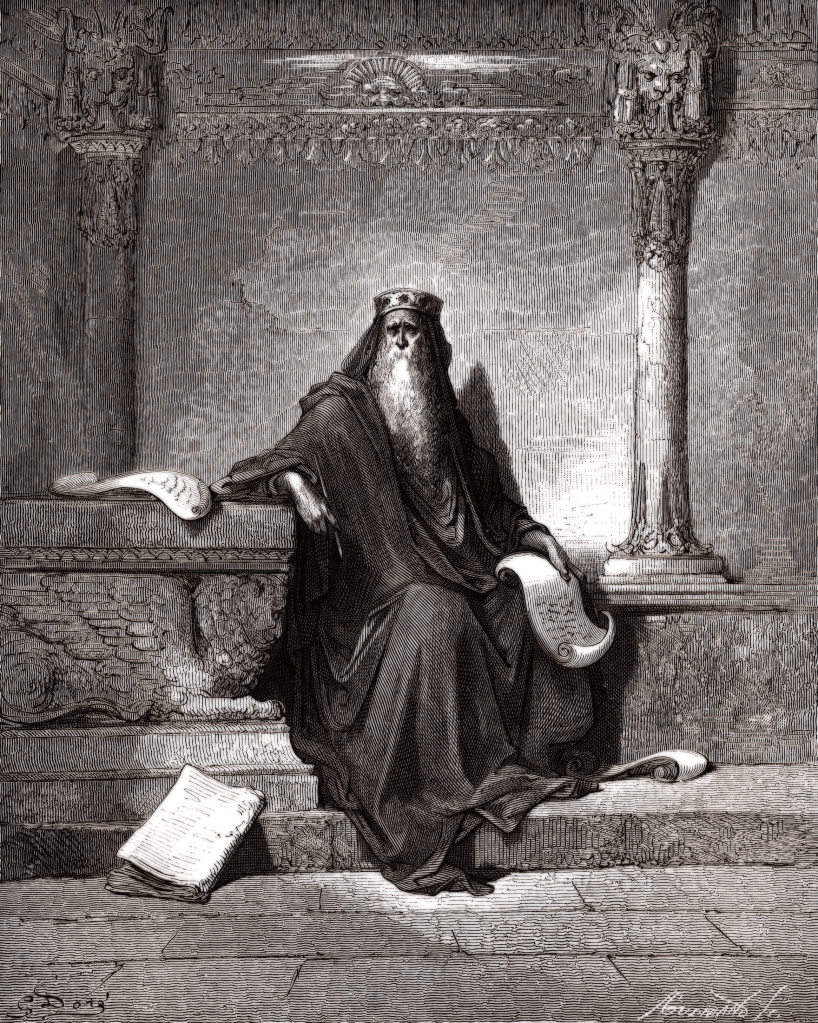
(King Solomon in Old Age by Gustave Doré (1866))
As you can imagine, Solomon is one figure in the biblical corpus I can identify with because of his value for and love of wisdom, his philosophia. However, despite wisdom being a good thing and something to strive for, he came to the realisation that the value, love and attainment of wisdom (philosophia) in and of itself will still inevitably lead to grief and sorrow, to melancholia.
The modern-day branch of philosophia known as Existentialism identifies the experience of melancholia as existential angst & anguish. This experience of angst & anguish is a subjective one which accompanies and couples an individual’s free choices, their moral responsibility for these choices and their seemingly absurd search for meaning & purpose in the world and their own lives through these choices.
Biblical figures, modern existentialists and even ancient philosophers all wrestled with the vanity, futility and absurdity of life and drew their own conclusions. Socrates, for example, concluded “the unexamined life is not worth living”. In other words, the non-reflective life is vain, futile and absurd.
But what is ‘vanity’ exactly?
There are three key aspects to the concept of vanity and for two I will use the tongues of the Akan people (viz. Twi & Fante) to help highlight the difference.
- Vanity is WASTE (Twi – AhuhudeƐ)
- Vanity is PRIDE (Fante – Egyangyandze)
The first aspect of vanity is WASTE (Twi – AhuhudeƐ):
4 – Lack of real value, hollowness, worthlessness
Dictionary.com
5 – Something worthless, trivial or pointless
(British dictionary)
4 – The state or quality of being valueless, futile, or unreal
5 – Something that is worthless or useless
(Latin)
Vanitas = emptiness
Vanus = empty
Where do we encounter vanity in scripture? In the very beginning, in the very first page and passage of God’s story of salvation:
Genesis 1:1-3 (KJV)“In the beginning God created the heaven and the earth.
And the earth was without form and void, and darkness was upon the face of the deep.
And the Spirit of God moved upon the face of the waters.
According to the Blue Letter Bible, the phrase “without form and void” derives from a rhyme in Hebrew tôû bôû (to’-hoo bo’-hoo). Where tôû (to’-hoo) derives from an unused root meaning ‘to lie waste’, and bôû (bo’-hoo) derives from a root meaning ‘to be empty‘. There is a reason for the rhyme: the reason being to signify the lack and the depravation of meaning and purpose without God’s presence.
The biblical usage of the first word tôû includes:
- formlessness – a lack of form, shape, definition
- confusion & chaos – a lack of clarity, direction, order
- unreality, nothingness and emptiness – a lack of truth, substance, depth
- wilderness & wasteland – a lack of control and vitality
The biblical usage of the second word bôû includes:
- Emptiness – to be deprived of depth
- Void – to be deprived of consequence or effect
- Waste – to be deprived of use, worth or purpose
Genesis 1 implicitly identifies the aspect of vanity as waste we recognise in the world and emphasises the significance of God’s presence moving and removing this waste from both our world and our lives. Genesis 1 explicitly shows the power of God’s presence to move and remove all vanity, futility and absurdity from our world and lives with a Word.
And the earth was without form and void, and darkness was upon the face of the deep.
And the Spirit of God moved upon the face of the waters.
And God said, ‘Let there be light‘: and there was light. “
Genesis 1:2-4(KJV)
The second aspect of vanity is PRIDE (Fante – Egyangyandze):
1 – Excessive pride in one’s appearance, qualities, achievements, etc.,
Dictionary.com
character or quality of being vain; conceit.
(British dictionary)
2 – Ostentation occasioned by ambition or pride
Where do we see the absence of pride, ambition or the concern for one’s appearance in scripture? In the Garden …
“And they were both naked, the man and his wife, and were not ashamed.”
Genesis 2:25 (KJV)
Where do we see the presence of pride, ambition or the concern for one’s appearance in scripture? Similarly, in the Garden …
“And when the woman saw that the tree was good for food and that it was pleasant to the eyes, and a tree desired to make one wise, she took of the fruit thereof, and did eat, and gave also unto her husband with her, and he did eat.
And the eyes of both of them were opened, and they knew they were naked; and they sewed fig leaves together, and made themselves aprons.
And they heard the voice of the LORD God walking in the garden in the cool of the day and Adam and his wife hid themselves from the presence of the LORD God amongst the trees of the garden.”
Genesis 3:6-8 (KJV)
In one direction, the presence of God moves in and removes the waste of vanity, in another direction the pride of vanity hides itself and moves from the presence of God. The love of God invites the former, the love of the world brings the latter. John warns us against this …
“Love not the world, neither the things that are in the world. If any man love the world, the love of the Father is not in him.
For all that is in the world, the lust of the flesh, the lust of the eyes, and the pride of life, is not of the Father, but is of the world.
And the world passeth away, and the lust thereof: but he that doeth the will of God abideth forever.”
1 John 2:15-17 (KJV)
According to the Blue Letter Bible, what is translated into English as the ‘pride of life’ derives from the Greek Alazoneia bios where the word “Alazoneia” (pride) covers …
- Empty, braggart talk
- An insolent and empty (self-)assurance
- An impious and empty presumption
The emptiness of the earth – the void – at the beginning before creation mirrors the emptiness of vanity – as pride – after the fall. Vanity as pride is not just sin but a sign. A sign that God’s creative work has been reversed and brought back to emptiness, back to the void.
Vanity & God’s Name
Perhaps these two aspects of vanity – waste and pride – are two implicit layers of sin warned against in the simplicity of the third commandment …
“Thou shalt not take the name of the LORD thy God in vain, for the LORD will not hold him guiltless that taketh his name in vain.”
Exodus 20:7 & Deuteronomy 5:11
Here, the Hebraic root word for vain is šāv’ (shawv) which differs from Solomon’s use of the word heḇel (hevel).
Here, the Hebraic root meaning for vanity as waste and pride is different from tôû bôû.
Here, šāv’ or vanity means ‘to desolate’.
The third commandment is explicitly warning us not to desolate God’s name, but what if the third commandment is implicitly warning us not to bring God’s name, signature and trademark to emptiness, nothingness or worthlessness? What if the third commandment is invoking us to move in the opposite direction of vanity and back to the original vision for our lives?
According to Genesis 1:28, this original vision would be:
- flourishing & fruition
- multiplication & increase
- replenishment & fulfillment
- dominion, control & responsibility
Despite the different words used, the root issue of reversing God’s creative work, handiwork & good work back to emptiness, nothingness and worthlessness is the same. In the different words used , we find the third aspect of vanity: DESOLATION.
So, what does vanity in the third commandment have to do with Tisha B’Av?
Remember that God’s creative work includes forming the nation of Israel at Mount Sinai and guiding their evolution to become a nation who could (politically) embody God’s acclaim, reputation and sovereignty. In short, God’s name. According to Joshua Berman,
“God’s acclaim can only be recognised broadly by the nations of the world if His providence is evidenced in the affairs of an entire nation.
… Consistently [the Book of Deuteronomy] refers to this Temple as ‘the place that God will select to establish His name’ … it is a telling statement of the Temple’s purpose: the Temple – ‘a house for God’s name’ – symbolizes a public declaration of God’s sovereignty. The ambition of declaring God’s sovereignty in the world, which was initiated by Abraham, is the calling of the Jewish people on a wider scale.”
The Temple, Joshua Berman, p.63
The Temple was a physical embodiment of God’s name. Tisha B’Av commemorates the destruction or desolation of the First & Second Temples at different times in history (circa 586 BC & AD 70, respectively).
If we couple our threefold understanding of vanity as waste, pride and desolation with this understanding of the Temple’s significance, we can infer that commemorating the desolation of the First & Second Temples is not (or should not be) seen as the ambitious pride of the people themselves but rather the desolation of their pride in being God’s called and chosen people.
When faced with the desolation of the Temples on Tisha B’Av, the Jewish people come face-to-face with the possibility of a vain, futile and absurd existence without God’s presence. When coming to terms with the reality of tragedies associated with Tisha B’Av, the Jewish people come face-to-face with the fact that the family business (e.g. Abraham’s commission from Genesis 12) and the family tradition (e.g. Mosaic law from Exodus 20) may just be a vain and futile pursuit when the Spirit of God does not move or work with them but rather moves or works against them. As expressed vividly and viscerally in the Book of Lamentations:
“The LORD was as an enemy: he hath swallowed up Israel, he hath swallowed up all her palaces: he hath destroyed his strongholds , and hath increased in the daughter of Judah mourning and lamentation.
And he hath violently taken away his tabernacle, as if it were of a garden: he hath destroyed his places of the assembly: the LORD hath caused the solemn feasts and sabbaths to be forgotten in Zion, and hath despised in the indignation of his anger the king and the priest.
The Lord hath cast off his altar, he hath abhorred his sanctuary, he hath given up into the hand of the enemy the walls of her palaces; they have made a noise in the house of the LORD, as in the day of a solemn feast. the LORD hath purposed to destroy the wall of daughter Zion …”
Lamentations 2:5-8 (KJV)
There is no image more apt to illustrate the vanity and futility of our projects and pursuits better than an image of burning, an image of our work ‘going up in flames’ and being reduced to ash. Unfortunately, on Tisha B’Av this is precisely what is remembered, and in the Book of Jeremiah this is precisely what is experienced and expressed:
Now in the fifth month [Av], in the tenth day of the month, which was the nineteenth year of Nebuchadrezzar king of Babylon, came Nebuzaradan, captain of the guard, which served the king of Babylon, into Jerusalem,
And burned the house of the Lord, and the king’s house; and all the houses of Jerusalem, and all the houses of the great men, burned he with fire:
And all the army of the Chaldeans, that were with the captain of the guard, brake down all the walls of Jerusalem round about.
Jeremiah 52: 12 -16 (KJV)
Vanity: the desolation of God’s name.
The Temple & Jerusalem: the embodiment of God’s acclaim, reputation and sovereignty going up in flames.
God’s name: reduced to ash, brought to emptiness, brought to waste.
Three words: Vanity. Futility. Absurdity.
The Myth of Sisyphus & The Road to Emmaus
Despite this image of despair, there are images of hope.
In existentialist philosophy, Albert Camus uses the myth of Sisyphus as an image from Greek mythology to illustrate our human condition and the inherent threat of vanity and futility in our projects and pursuits.
The gods had condemned Sisyphus to ceaselessly rolling a rock to the top of a mountain, whence the stone would fall back of its own weight. They had thought with some reason that there is no more dreadful punishment than futile and hopeless labor.
The Myth of Sisyphus, Albert Camus, (emphasis mine)
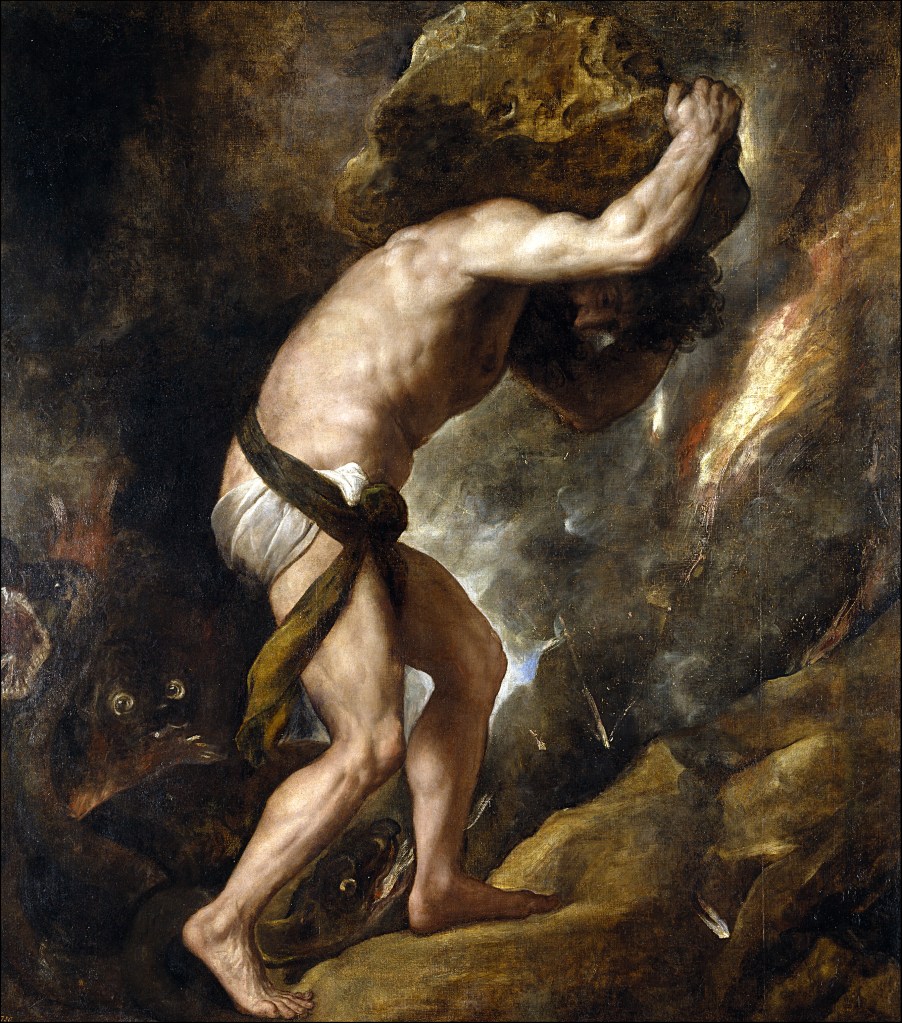
(Punishment by Titian)
This could potentially be an image of despair for us but Camus concludes his essay in such a way as to reverse this into an image of hope …
One always finds one’s burden again. But Sisyphus teaches the higher fidelity that negates the gods and raises rocks. He too concludes that all is well. This universe henceforth without a master seems to him neither sterile nor futile. Each atom of that stone, each mineral flake of that night filled mountain, in itself forms a world. The struggle itself toward the heights is enough to fill a man’s heart. One must imagine Sisyphus happy.
The Myth of Sisyphus, Albert Camus (emphasis mine)
Punishment by Titian
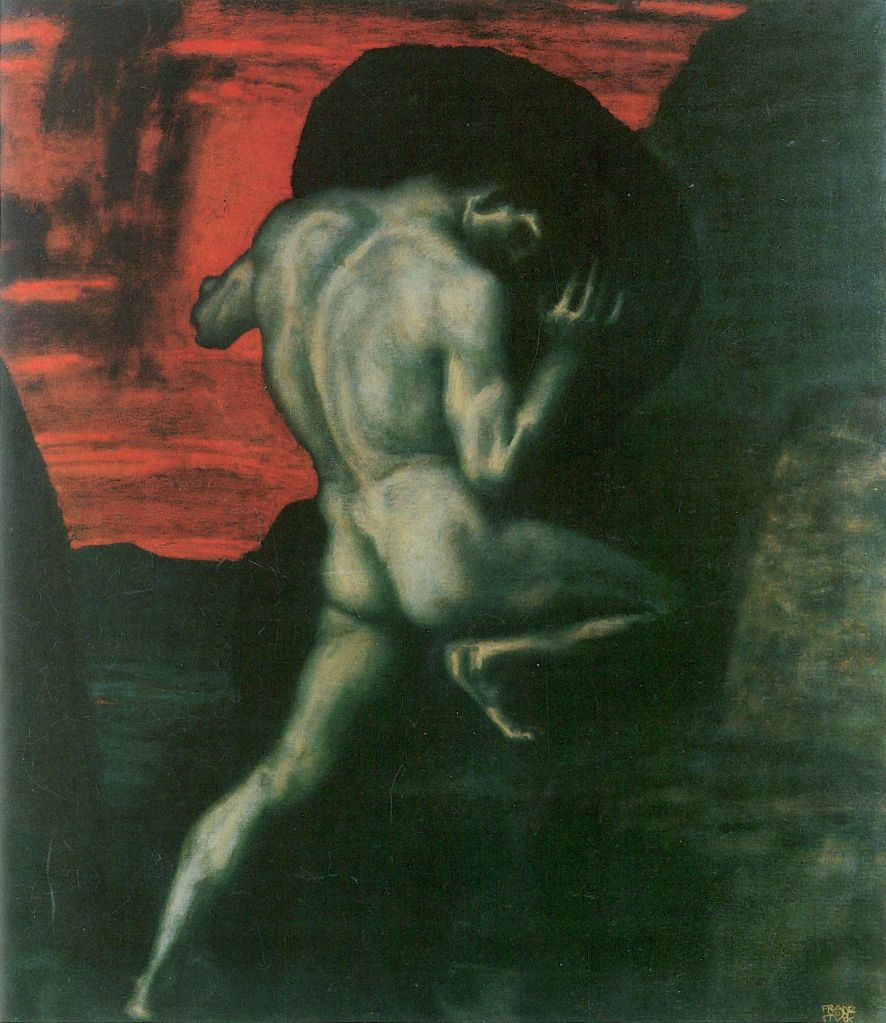
(Sisyphus by Franz Stuck)
In essence, Camus has three main points:
- The myth of Sisyphus “teaches a higher fidelity”, a higher faith or faithfulness.
- Even without a master of the universe, the world is “neither sterile or futile” and so has meaning and purpose.
- The meaning and purpose of life can be found in the “struggle towards the heights” itself, the challenge itself of aiming or moving upwards.
However, with these three points come three questions:
- If Sisyphus teaches us a higher fidelity (i.e. a higher faith or faithfulness), we can simply ask “faith in what or faithfulness to what exactly”? What exactly does Sisyphus believe in or what exactly is Sisyphus committed to?
- If there is no master of the universe, then what is the end goal? Endless repetition? Are we advocating for an existential acceptance of Groundhog Day or existential submission to A Series of Unfortunate Events?
- If Camus’ answer to the first question is faith in the struggle towards the heights itself or committment to the challenge itself of aiming upwards, I simply ask why aim upwards if there is nothing of substance there? Why climb the Mountain or World’s Tree if there is no one to meet you there?
In biblical tradition, Jesus uses an image from Jewish scriptures to illustrate the Jewish condition and the seemingly inherent threat of vanity and futility in their project and pursuit to make God’s name known to the nations.
Jesus answered and said to them, ‘Destroy this temple, and in three days I will raise it up.’
Then the Jews said, ‘It has taken forty-six years to build this temple, and will You raise it up in three days?’
But He was speaking of the temple of His body.”
John 2:18-21 (NKJV)
This also could be an image of despair but instead it is reversed into an implicit image of hope …
The destruction of the Temple illustrates vanity and futility, a sign of wasted effort on the part of the Jewish people. But the reverse, the raising of the Temple, is an image of hope, a sign of the Messiah. Hope in a Master of the universe who is the cure for not only the Jewish condition but our human condition, and the aid to what would otherwise be our vain and futile efforts to make a name for ourselves.
In the scriptures there are many images of hope used to inspire, encourage and uplift us today. On the Road to Emmaus, the disciples needed to be reminded of these images when falling into despair after the death of the Messiah, the crucifixion of Christ.
Then [Jesus] said unto them, O fools, and slow of heart to believe all that the prophets have spoken:
Ought not Christ to have suffered these things, and to enter into his glory?
And beginning at Moses and all the prophets, he expounded unto them in all the scriptures the things concerning himself.
Luke 24: 25 -27 (KJV)
The Christ, the human embodiment of God’s name, would have to suffer and enter into his glory? What a paradox.
The Messiah, the manifestation of God’s name, would have to suffer in order to enter into his glory? What an absurdity.
If I were on the Road to Emmaus, I would have questions and need to hear further:
- What would be the absurd and paradoxical images of suffering & glory?
- What would be the images of desolation remembered and reversed in order to remain hopeful?
- What would be the images of vanity & futility of life reversed into faith & hope in God?
This year, when I contemplate the events of Tisha B’Av, I believe that Jesus would start here:
“And the angel of the Lord appeared unto [Moses] in a flame of fire out of the midst of a bush: and he looked, and, behold, the bush burned with fire, and the bush was not consumed.”
Exodus 3:2 (KJV)
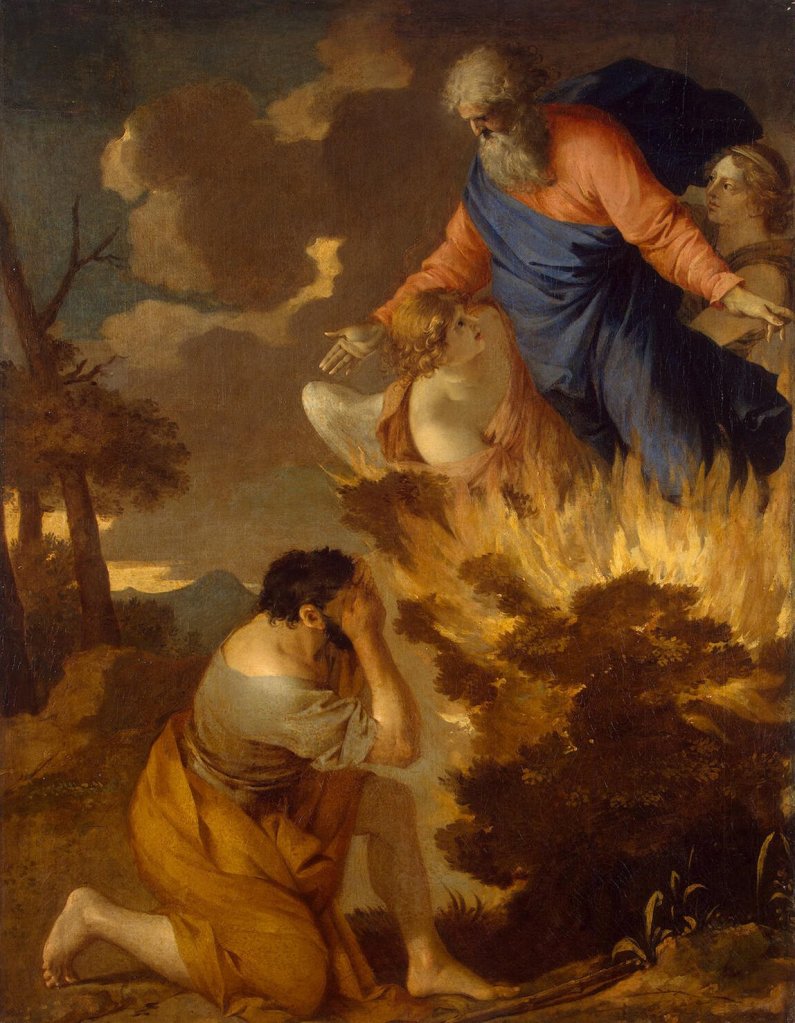
(Burning Bush by Sébastien Bourdon)
I burn but I am not consumed.
I AM THAT I AM.
God’s name.
Bibliography
(Anon.). The Holy Bible, King James Version. Harper Collins Publishers.
(Anon.) 1982. The Holy Bible, New King James Version. Nashville, Tennessee: Thomas Nelson, Inc.
Berman Joshua. 1995. The Temple: Its Symbolism and Meaning Now and Then. Joshua Berman. Wipf & Stock: Eugene, Oregon.
Blue Letter Bible. Genesis 1. Available at: <https://www.blueletterbible.org/kjv/gen/1/1/s_1001>
Blue Letter Bible. Genesis 1 concordance. Available at: <https://www.blueletterbible.org/kjv/gen/1/1/t_conc_1002>
Blue Letter Bible. 1 John 2 concordance. Available at: <https://www.blueletterbible.org/kjv/1jo/2/1/t_conc_1161016>
The Myth of Sisyphus. Available at: <https://en.wikipedia.org/wiki/The_Myth_of_Sisyphus>
Sisyphus. Available at: <https://en.wikiquote.org/wiki/Sisyphus>
Doré, Gustave: King Solomon in Old Age. Available at: <https://commons.wikimedia.org/w/index.php?curid=107310587>
Bourdon, Sebastien: Burning Bush. Public Domain. Available at: <https://commons.wikimedia.org/w/index.php?curid=10586813>
Stuck, Franz: Sisyphus. Public Domain. Available at: <https://commons.wikimedia.org/w/index.php?curid=55248>
Titian: Punishment. Public Domain. Available at: <https://commons.wikimedia.org/w/index.php?curid=3860214>
Playlist
Rivers Run – Karine Polwart
God-Shaped Hole – Plumb
I Still Haven’t Found What I’m Looking For – U2
Turn – Travis
Thousand Words – Cordae
Mo’ Money – J. Cole
Chaining Day – J. Cole

 Sy 'Adamah #SageSpeaks